
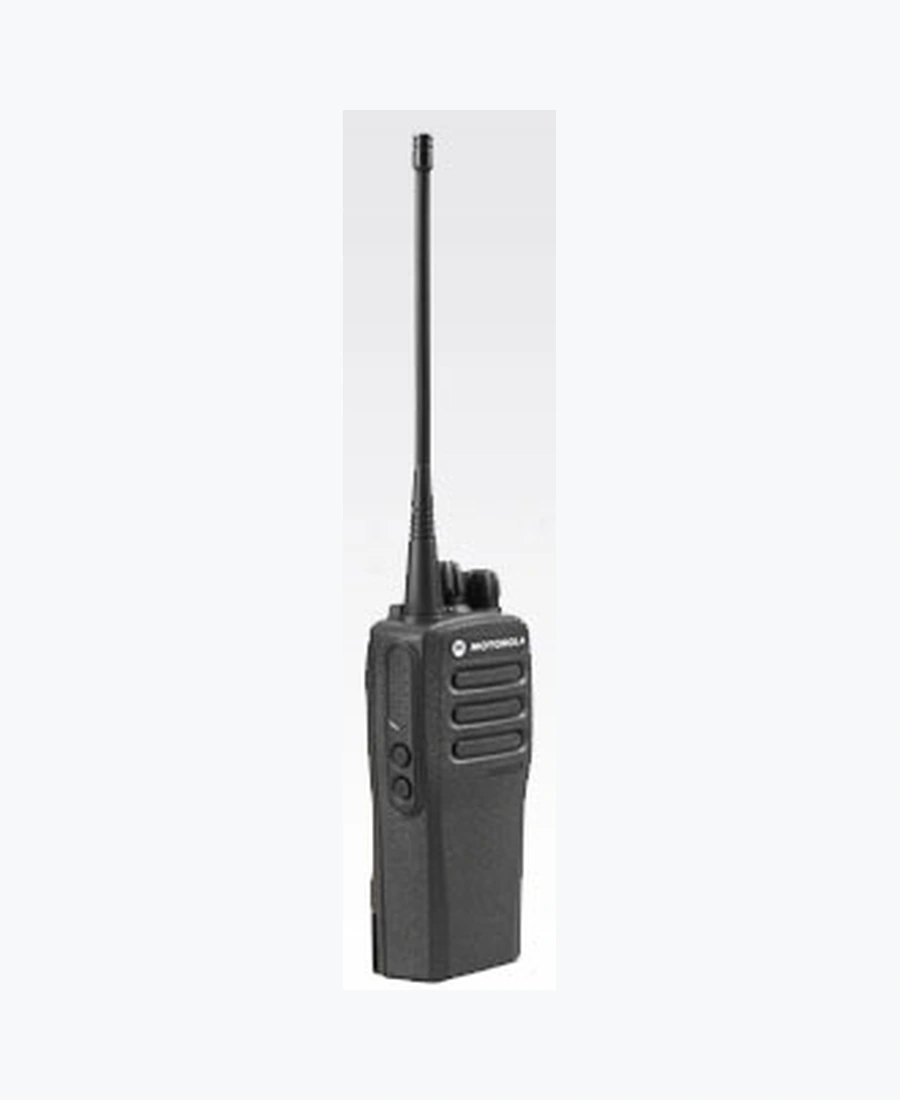
What is checked when a radio does not deliver the expected result.
A service check is meaningful only when the radio is evaluated with the battery, antenna and accessories the user actually uses. Incorrect configuration can appear to be a fault even when the hardware is sound.
Power and battery
Battery condition, contacts, charging and radio behaviour under load are checked.
Transmit and receive
Basic RF functionality, on-channel behaviour and compliance with the system configuration are checked.
Audio path
The microphone, speaker, audio-accessory connector and remote speaker microphone are checked as part of normal daily use.
Antenna and connector
A mechanically damaged or loose antenna connector can cause unstable operation and poor range.
Programming status
Configuration is compared with the expected channel plan; a group, tone or DMR parameter may be the source of the problem.
Functional test
After intervention, the radio is tested in communication with a representative radio or system.
The codeplug follows the user organisation, not the other way around.
In analogue systems, programming covers channels, tones, channel bandwidth, power and scan. In DMR systems, supported options such as Color Code, Time Slot, Talkgroup/Contact, RX Group and zones are configured for the specific model.
A faulty radio and a system-wide problem are not the same thing.
If several radios have the same problem, the cause may extend beyond an individual service case. Programming, antennas, RF infrastructure and coverage are then checked.
What is checked before a decision is made
Before deciding on an intervention, we review the symptoms, current configuration, RF path, associated accessories and operating conditions at the site.
The intervention ends with verification and documentation.
The purpose of final verification is to confirm the function the user needs in real operation, not merely that the radio passes a basic bench check.
Send us the radio model and as precise a description of the symptom as possible.
State when the problem occurs, whether it affects multiple radios, which accessories are used and whether the system configuration has changed. This speeds up separation of hardware, RF and programming issues.