Active View display
The concealed LED display shows channel, radio and volume information without a conventional large screen.

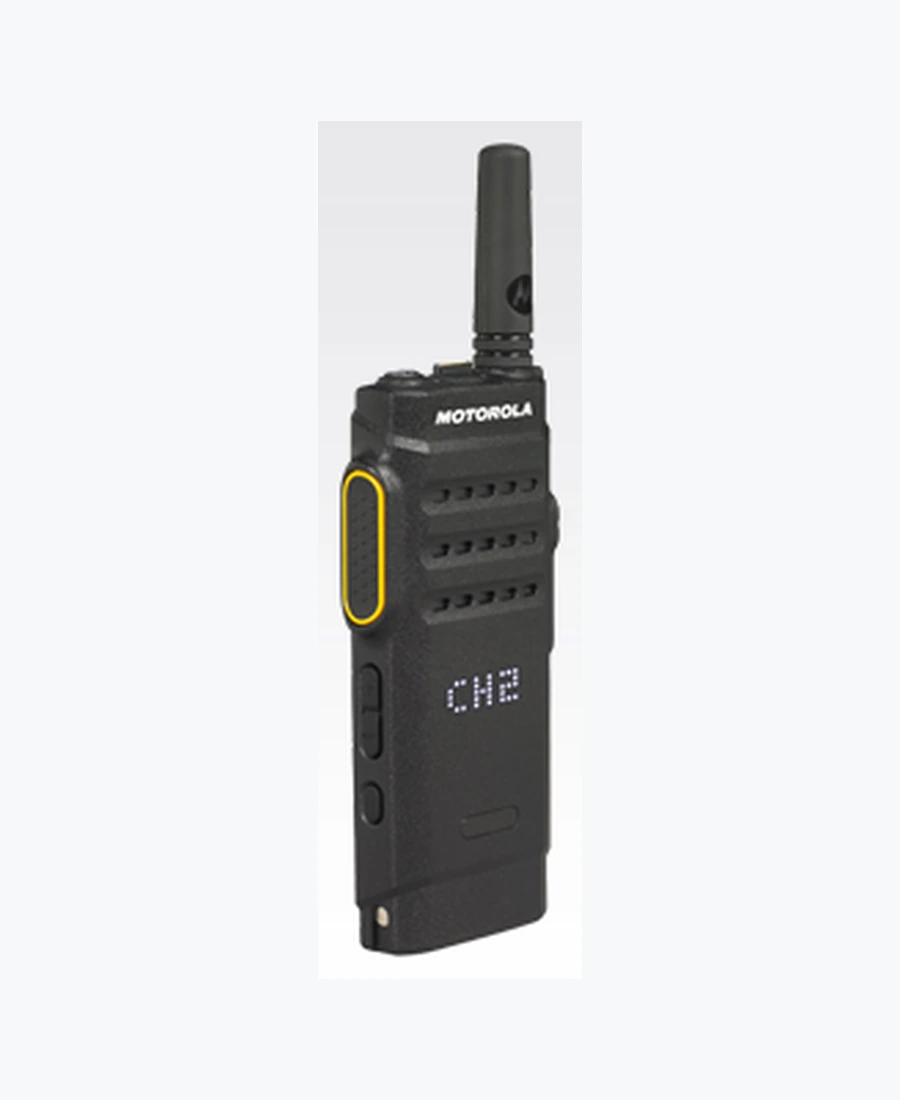
An ultra-slim professional handheld radio for users who value discreet carrying, low weight and simple operation as much as the radio link itself. It is particularly practical for protocol, production, events, hospitality, reception and other roles where a large rugged radio is not the optimal choice.
The SL1600 is approximately 22 mm thick and uses a concealed Active View LED display, a dedicated power control, side volume controls and a top channel toggle. It supports analogue and DMR operation, including Dual Capacity Direct Mode in an appropriate digital configuration. According to the manufacturer’s specification, MicroUSB is used for connectivity and programming/charging. In the rental system, the radio is configured for simplicity so users receive only the channels and functions required for their role.
Specifications alone do not determine whether a model is right for a project. They must be considered together with the RF environment, user role, audio accessories, batteries and compatibility with the rest of the system.
Technical source: Motorola Solutions — SL1600. Rental configuration and the condition of the actual device are checked before handover.
Features are not enabled simply because they appear in a catalogue. They are used only when they suit the operating scenario and are supported by the exact device variant and the rest of the system.
The concealed LED display shows channel, radio and volume information without a conventional large screen.
In a DMR direct-mode configuration, the model supports two TDMA time slots on a 12.5 kHz channel without a repeater when the system is programmed correctly.
Voice announcement of supported changes allows the user to confirm an action without looking at the radio.
The manufacturer provides MicroUSB connectivity for efficient charging and straightforward programming.
Motorola specifies an advanced receiver and antenna design intended to improve range within the slim housing; actual range still depends on RF conditions.
PTT, channel, volume and power controls are arranged so the essential functions remain accessible without navigating complex menus.
Batteries, charging, audio accessories, antennas and carrying method are selected according to shift duration, noise level, discretion, protective equipment and user role. Compatibility is confirmed for the actual device.
Operating time depends on the mode, PTT duty cycle and condition of the individual battery.
For larger teams, centralised charging is planned using a suitable compatible system.
Earbud, D-style and surveillance options are useful for protocol, hospitality and security roles.
Belt clips and other carrying options preserve the advantage of the slim housing.
The antenna must match the frequency variant of the radio.
Channels, voice announcements and other functions are configured according to the user role.
For predictable operation, the programming profile, audio accessories, battery and RF infrastructure must all follow the same system plan.
The examples below are not limitations of the model; they are common scenarios where its characteristics and accessories are a practical fit within a rental system.
Discreet carrying, simple controls and a low visual profile.
Coordinators, production staff and organisational roles that require frequent movement.
Reception, facility staff and users working in public-facing areas.
Discreet roles with suitable audio accessories and programmed groups.
The model, accessories and infrastructure must match the site, operating method and programming plan for the specific project.
Provide the location, dates, number of users, zones and shifts. Before handover, we confirm the exact variant, compatible accessories, programming profile and functional condition of the complete set.